 My Real Test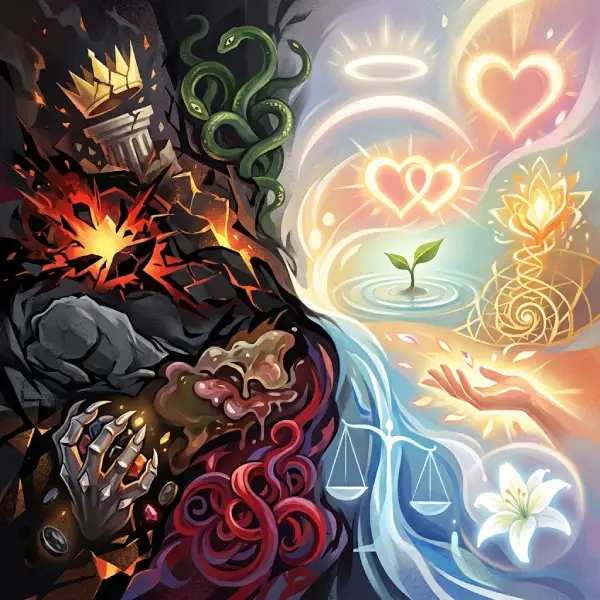
Seven Deadly Sins vs. Seven Virtues Test
Free online personality test measuring the seven deadly sins and seven virtues across 14 dimensions. 35 questions, instant spectrum result, no sign-up required.
About This Test
The seven deadly sins are the classic Western summary of human nature: pride, envy, wrath, sloth, greed, gluttony and lust. Facing them stand the seven virtues: humility, charity, patience, diligence, generosity, temperance and chastity. This test turns those 14 dimensions into 35 questions (28 five-point scale items plus 7 situational either/or scenarios), with some items reverse-scored to reduce response bias.
When you finish, you'll get a mirrored personality spectrum: the left half maps your seven sinful tendencies, the right half your seven virtuous ones, aligned along a central axis. Every dimension scores 0–100 as a relative value — a higher score doesn't mean better or worse, only that the tendency is stronger in you.
All answers are processed locally in your browser. Only anonymous start/finish counts are reported for popularity stats — your individual answers are never stored or analyzed.
How It Works
- 135 questions in total: 28 five-point scale items plus 7 either/or scenario questions
- 2Answer with your first reaction — no overthinking — about 5–7 minutes
- 3Some items are reverse-scored (a standard psychometric design); just answer honestly
- 4Your result is a 14-dimension spectrum: seven sins on the left, seven virtues on the right, mirrored along the axis
- 5Your dominant type (15 types in total) is determined by the sin–virtue balance index
Why Take It
Self-discovery
Understand your behavioral patterns and inner drives — the "why do I always react this way"
Relationships
Take it with a partner or friends and compare spectrums to talk about how you differ
Work & growth
See your natural reactions under pressure, temptation and conflict, and find a rhythm that fits you
Creative writing
Use the 14-dimension spectrum to build character personalities and arcs
Results Preview
See the Two Forces Inside You
14 Glossary
FAQ
Will this test "condemn" me?
No. The seven deadly sins are a classic framework for human weaknesses. This test neutrally measures behavioral tendencies — it makes no moral judgment and is not a psychological diagnosis. It simply helps you see your most natural coping patterns.
How do the sins and virtues pair up?
Traditionally they map one-to-one: pride↔humility, envy↔charity, wrath↔patience, sloth↔diligence, greed↔generosity, gluttony↔temperance, lust↔chastity. Your result shows these seven pairs as a spectrum so you can see how the two forces shift.
How long does it take?
35 questions in total: 28 five-point scale items and 7 either/or scenarios, usually 5–7 minutes. There's no time limit per question — answer with your first reaction.
Are my answers stored or uploaded?
No. All answering and scoring happen locally in your browser. We never store, upload or analyze your individual answers.
How should I read my result?
Every dimension is a 0–100 relative value — higher doesn't mean better, only stronger. Focus on the relative strength between sins and virtues, and on your highest-scoring sin and virtue: that's usually the most authentic you.
Why does the test use reverse scoring?
Some items are reverse-scored (e.g. "it usually doesn't bother me" actually measures envy) to reduce habitual answering. This is a standard psychometric technique that makes results closer to your real state.
Related Tests
Dark Triad Test
Classic SD3 scale: 27 questions measuring Machiavellianism, Narcissism and Psychopathy, with your dark spectrum and type reading. Free, no sign-up.

Dream Personality Test: Fantasy or Inner Calm
A 16-question dream quiz revealing your dominant style—Fantastical Dreamer or Still Reflection—and what your dreams reveal about your creativity and calm.